
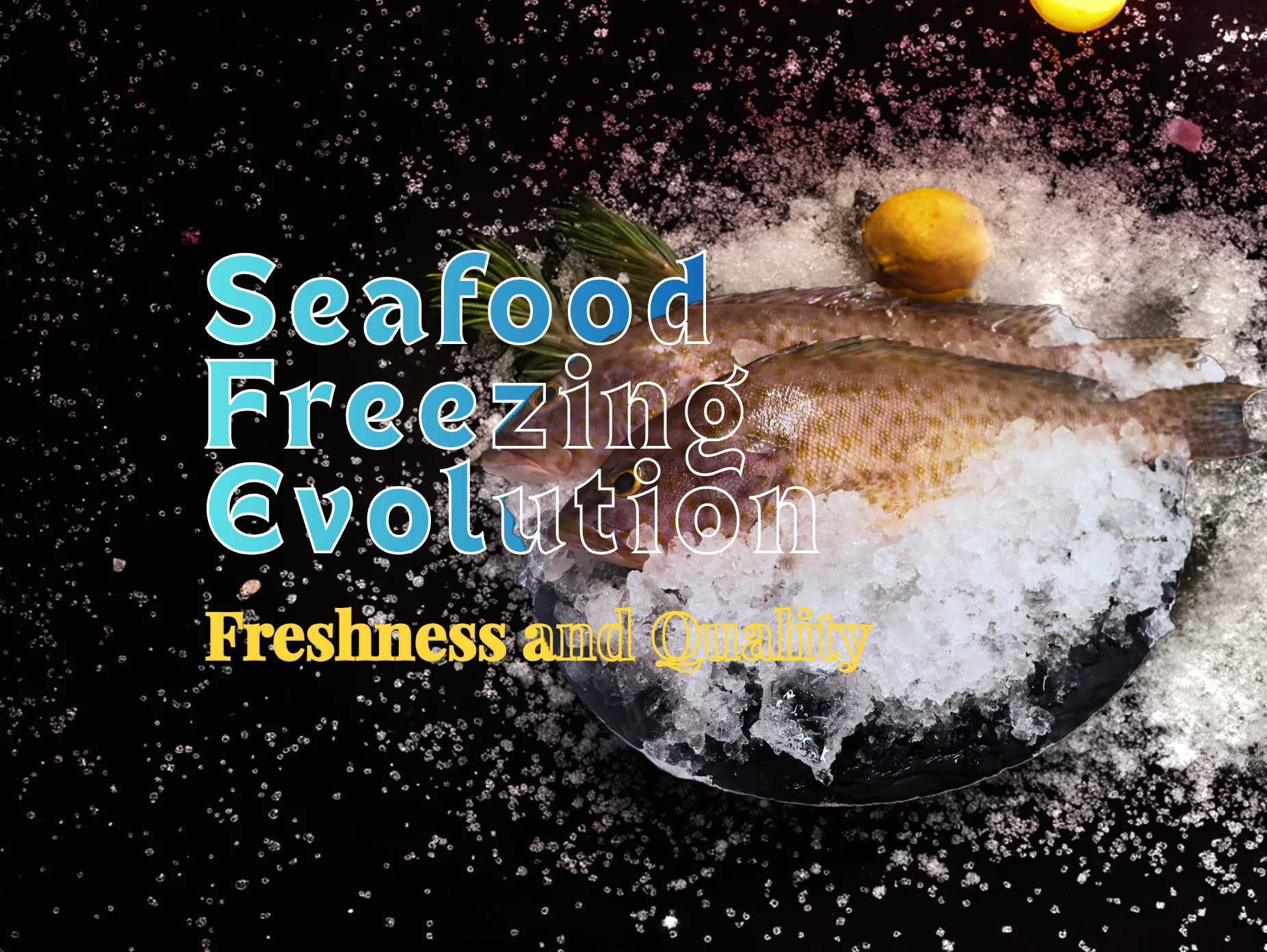
The Evolution of Seafood Freezing: Key Techniques for Freshness and Quality
From ancient ice harvesting and natural cold storage to today’s ultra‑rapid cryogenic seafood freezing systems, freezing technologies have fundamentally transformed food preservation, especially within the seafood industry [1]. These innovations have made it possible to maintain freshness, flavor, and nutritional value, enabling the year‑round global trade of premium seafood such as tuna, grouper, sillago, and mahi‑mahi, regardless of season or distance. Together with Vinh Phat Food, let us explore the fascinating history of marine fish preservation: from early traditional methods rooted in nature to the modern industrial freezing technologies that shape today’s global seafood supply chain.
1. From Ancient Ice Storage to the Dawn of Industrialization (Pre-19th Century)
Long before modern refrigeration, freezing began as a natural solution shaped by environment and necessity. As early as 1000 BCE, ancient Chinese civilizations developed ice cellars to store and preserve food. Ice was harvested during winter, transported, and stored in underground icehouses within royal palaces, where it was used to preserve food – especially prized seafood served to the Emperor [2]. Meanwhile, Inuit communities in the Arctic, documented as far back as prehistoric times, relied on sub‑zero temperatures and strong winds to naturally flash‑freeze fish and game, ensuring long‑term preservation in extreme climates.
These methods emerged from necessity in cold climates, motivated by seasonal food abundance and the need to survive harsh winters or long migrations, problems like immediate spoilage in warmer periods drove innovation.
For seafood, this solved basic decay issues by inhibiting microbial growth through ice formation, extending usability from days to weeks. However, limitations included geographic dependency and inconsistent quality, often resulting in texture damage from large ice crystals. In your marine-focused operations, these early insights underscore the value of controlled environments for grouper preservation, preventing the mushy consistency seen in poorly frozen fillets.
2. Industrial Breakthroughs in Freezing Technology (Late 19th to Early 20th Century)
The late 19th century marked a turning point in food preservation as mechanical and scientific approaches began to replace traditional ice‑harvesting methods. In the United States, the U.S. Fish Commission was already conducting research on fish handling and preservation by the early 1880s, including experiments involving ice and salt mixtures to slow spoilage [6]. These early efforts laid groundwork for more advanced freezing technologies.
By the 1910s–1920s, American naturalist Clarence Birdseye made his pivotal observations during fieldwork in Labrador, where he witnessed Inuit communities exposing freshly caught fish to frigid Arctic air, causing them to freeze almost instantly. When thawed months later, the fish retained remarkable freshness – an insight that inspired Birdseye to replicate rapid freezing mechanically. His work was driven by growing urban populations, unreliable natural ice supplies, and the commercial need to reduce spoilage in transported seafood.
Birdseye’s early prototypes directly addressed the quality loss caused by slow freezing, which produced large ice crystals that ruptured cellular structure and degraded texture, problems well‑documented in early frozen foods. His innovations significantly improved flavor and texture retention in fish fillets, including species like cod and other whitefish.

Between 1924 and 1929, Birdseye patented his multi‑plate quick‑freezing system, which pressed packaged food between super‑chilled metal plates to freeze it rapidly. In 1930, he launched the first retail frozen foods, effectively creating the modern frozen food industry. His rapid‑freeze method (often reaching temperatures around –40°C) minimized ice‑crystal formation and dramatically reduced post‑harvest waste, which had been a major issue in fisheries.
For seafood exporters, this revolutionized global trade. Faster freezing reduced drip loss during thawing and preserved firmness, making species like grouper far more viable for long‑distance shipment. By the 1940s, Birdseye’s innovations helped drive widespread adoption of home refrigerators, further accelerating consumer acceptance of frozen seafood
3. Mid-20th Century Advancements and Industrialization (1950s-1980s)
The 1950s-1980s industrialized seafood freezing, building on post-war quick-freezing adoption. In Newfoundland (1940-1969), production shifted to frozen fillets, driven by wartime protein needs and North American demand; factory trawlers enabled efficient blocks, surpassing traditional saltfish. This addressed texture inconsistencies from slower methods by forming smaller ice crystals, reducing post-harvest losses—foundational for high-value fish like grouper. Cryogenic freezing emerged commercially around 1960 using liquid nitrogen at -196°C, motivated by post-WWII gas availability and superior quality demands over mechanical systems.
Cryogenics solved oxidation and clumping in bulk processing via ultra-rapid immersion or spray, creating micron-sized ice crystals. This significantly cut drip loss (30-50% less than mechanical methods), preserving moisture, cellular structure, and nutrients in delicate mahi-mahi steaks, enhancing “ocean-fresh” appeal. Individual Quick Freezing (IQF), building on fluidized bed principles, gained widespread adoption in the 1970s-1980s, particularly for Southeast Asian exports like Thai shrimp, where intensive aquaculture boomed. IQF enabled separate freezing of portions on conveyors, preventing adhesion and allowing easy retail packaging, solving clumping in bulk blocks and supporting portion control for global trade.
This era industrialized seafood supply chains, boosting yields and year-round availability, but drew critiques for energy intensity: cryogenic systems consumed 4-17 times more energy equivalents than mechanical ones due to gas production, amid 1970s oil crises, prompting hybrids for efficiency. During this period, Southeast Asia saw the rise of major seafood‑processing hubs such as Thailand, Indonesia, and the Philippines. IQF technology enabled Thai shrimp to meet the portion‑control requirements of the U.S. and Japanese markets, while the expansion of cold‑storage facilities and freezing systems paved the way for large‑scale exports of frozen seafood. Although cryogenic freezing remained less common due to its high cost, IQF became the dominant technology, shaping the region’s seafood export industry for decades to come.
4. Modern and Emerging Technologies (1990s-Present)
From the 1990s to the 2020s-2025, innovative assisted freezing technologies have emerged to address traditional methods’ limitations, driven by sustainability demands, climate impacts on fisheries, and consumer preferences for premium, nutrient-rich seafood. Ultrasonic-assisted freezing (UAF), developed in the early 2000s and refined through 2024 studies, uses sound waves (e.g., multi-frequency or orthogonal ultrasound) to induce cavitation, promoting uniform nucleation and smaller ice crystals.
This accelerates freezing rates by up to 30%, reduces energy consumption by 20%, and better preserves omega-3 fatty acids, texture, and water-holding capacity in species like sea bass, large yellow croaker, and mahi-mahi fillets—minimizing drip loss and oxidation during storage.
Magnetic-assisted freezing, including the Cells Alive System (CAS) commercialized in the 2000s (with ongoing applications in Taiwan/Japan through 2024), applies oscillating or static magnetic fields to vibrate water molecules, suppressing large crystal formation for “cells alive” preservation. Recent 2025 research on static magnetic field-assisted immersion freezing (SMF-LIF) shows enhanced myofibrillar protein stability and quality in golden pompano.

Hybrid systems, such as high-salinity brine freezing (e.g., Frostix’s HybridICE, promoted in 2024 for ultra-rapid immersion at -21°C [8]), combine brine with advanced cooling for eco-friendly, high-throughput processing suitable for shrimp and robust fish.
These solve energy inefficiency, nutrient degradation, and post-harvest waste (up to 30% reductions), enabling longer shelf life without additives-ideal for export-oriented grouper/mahi-mahi. However, critiques include high upfront costs and limited scalability for irregular shapes, though hybrids mitigate this for SEA processors.
Conclusion
From ancient ice pits to today’s AI‑enhanced freezing systems, the evolution of freezing technology has transformed global seafood preservation—reducing spoilage, minimizing waste, and improving product quality across a market valued at over USD 32 billion in 2025 [10]. Modern innovations such as IQF (Individual Quick Freezing) have become essential for maintaining the natural texture, flavor, and nutritional value of seafood, outperforming traditional slow‑freezing methods.
Vinh Phat Food leverages these advanced freezing technologies to deliver consistently “ocean‑fresh” grouper, mahi‑mahi, and other premium species. By integrating high‑performance cold‑chain systems, we help partners improve yields, enhance sustainability, and meet the rising global demand for high‑quality frozen seafood.
Explore our technology‑driven portfolio and connect with us to build a customized freezing solution tailored to your supply‑chain needs.
References
- Brian A. Nummer, Ph.D., Historical Origins of Food Preservation, https://nchfp.uga.edu/resources/entry/historical-origins-of-food-preservation
- Li, Haiying. “Study on the Ice Cellar Ruins in Early Ancient China.” Athena Transactions in Social Sciences and Humanities, 2022.
- Library of Congress, Who invented frozen food? https://www.loc.gov/everyday-mysteries/technology/item/who-invented-frozen-food/
- Birdseye, C. METHOD OF PRESERVING PISCATORIAL PRODUCTS. U.S. Patent Office. April 18, 1924. https://patentimages.storage.googleapis.com/b7/d9/5a/aeb7fae023f47e/US1511824.pdf
- Khadatkar, R. M., Kumar, S., & Pattanayak, S. C. (2004). Cryofreezing and cryofreezer. Cryogenics, 44(9), 661–678. https://doi.org/10.1016/j.cryogenics.2004.03.008
- UNITED STATES COMMISSION OF FISH AND FISHERIES. REPORT OF THE COMMISSIONER FOR 1882: A. INQUIRY INTO THE DECREASE OF FOOD-FISHES. B. THE PROPAGATION OF FOOD-FISHES IN THE WATERS OF THE UNITED STATES. https://penbay.org/cof/cof_1882.html
- Huan Yu, Jun Mei, Jing Xie, New ultrasonic assisted technology of freezing, cooling and thawing in solid food processing: A review, https://doi.org/10.1016/j.ultsonch.2022.106185
- SeafoodSource, Frostix’s HybridICE technology concentrates on high-salinity brine for seafood freezing, https://www.seafoodsource.com/news/processing-equipment/frostix-s-hybridice-technology-concentrates-on-high-salinity-brine-for-seafood-freezing
- Lin CY, Chang WJ, Lee SY, Feng SW, Lin CT, Fan KS, Huang HM, Influence of a static magnetic field on the slow freezing of human erythrocytes, https://pubmed.ncbi.nlm.nih.gov/22862742/
- Mordor Intelligences, Frozen Seafood Market Size & Share Analysis – Growth Trends And Forecast (2025 – 2030), https://www.mordorintelligence.com/industry-reports/frozen-seafood-market



Leave a Reply